Willemstad, Curacao - Arrived January 8, 2005
(Written by Steve Jan 8, 2005) - received January 8
We have arrived in Curacao
(Written by Steve Jan 8, 2004) - received January 11
I am still trying to figure out why this ship comes all the way down here to Curacao, it’s a really long way from Florida. Then we get back into the roughest sea I have ever been in (Caribbean Sea) and burn all the way back up to the Panama Canal, it’s a long way. Hey, don’t get me wrong, Willemstad is a very cool place and I am very glad to be here, especially since it’s dumping snow back in B.C., but we are here for only a day.
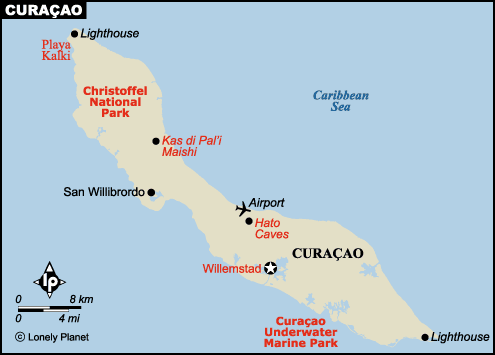
Curacao was protected by the British in the 1800’s and then turned it over to the Dutch in 1863. The Royal Dutch Shell Company chose to come to Curacao with its perfect harbour and political stability. The site was an excellent location to build a refinery and process Venezuelan oil. The refinery brings prosperity to Curacao and people come from all parts of the world to work here. Willemstad is the capital and full of 18th century Dutch colonial houses that look over St. Anna Bay. The island itself is 60 km long by 12 km wide and has a population of 175,000. The currency is the Netherlands Antilles Florin and Guilder. I have never been to Bermuda, but I have always imagined it would look just like this place. Except Willemstad has a lot of refinery stacks and it kind of takes away from the whole cute Dutch feeling thing. It is really beautiful here and you can walk right into town from the ship, and not even the rain will stop us. After getting roughed up for the last two days by the ship, it’s so nice to be on land. We are going to spend most of the day at the beach, even with rain. I didn’t think Helen was going to be coming right away, because she did not sleep a wink last night due to the rough seas, but she got up and we all went to the beach.
The beach is nothing less than superb; it stretches out in the shade of coconut palms and is completely vacant because of the rain. The beach we are on is called Kontiki Beach and is located right next to the Breezes hotel and the Plaza. This place is usually humming with activity I’m sure, but not today, we were the only ones. We did a bit of shopping and had been on the beach for about and hour playing soccer with Mark from Amsterdam. We then went to a bar restaurant located right beside the beach, it was very tropical. There were about 20 grass huts that hold 6 people each and someone from the restaurant comes over and takes your order. This was very cool and we were glad the rains had let up a bit so we could relax and have some food and drinks. Our Taxi driver came back and picked us up and took us for a tour to a bit of a tourist shops that overlooked the Spanish Waters Bay. In the bay you could see a big oil rig that had been brought in for repairs and it was cool because we have never seen one before. After about an hour of sightseeing, Franklin (Our Taxi Driver) took us back to the ship. It was a great day considering it monsooned down rain till 3pm and then lightly rained for the rest. Back to the ship for another bumpy ride to Panama City. I really hope not.
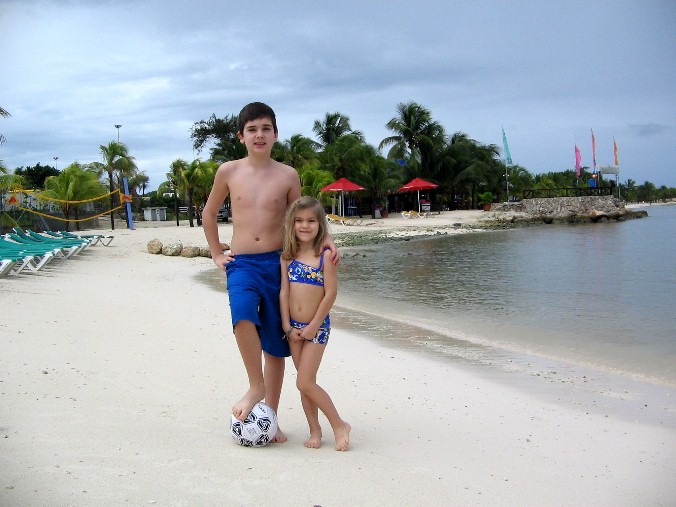
Kontiki Beach
*************************************************************************************************
(Info below taken from Internet - webmaster)
Willemstad, the capital of Curaçao consists of two parts namely Punda and
Otrobanda. Punda itself was established in 1634, when the Dutch captured the
island from Spain. The original name of Punda used to be de punt in
Dutch, in Papiamentu punta which literally means the point. This later
degenerated to Punda.
Otro banda means the other side. The name originated in 1707 when the first
buildings were constructed on the western side of Santa Anna Bay and
Willemstad's inhabitants needed to distinguish the new part of town from the
older part, Punda. Otrobanda is the historical melting pot, where from the
synthesis of many races, nationalities, cultures and languages, Curaçao's
culture originated.
 The
Handelskade or Trading Quay in the language of the people known as Awa
sá, lies on the Punda site. In former days this quay was known as the
waterside. The name of this quay has a historical explanation. Up to the end of
the 19th century this was the main mooring place for ships. The most important
buildings such as offices and warehouses of Willemstad were situated along the
quays. The unique architecture and red tiled roofs call Amsterdam to mind. The
tiles came from Europe as ships' ballast. After the ships were discharged, they
were loaded with salt from the saltpans for the curing of herring.
The
Handelskade or Trading Quay in the language of the people known as Awa
sá, lies on the Punda site. In former days this quay was known as the
waterside. The name of this quay has a historical explanation. Up to the end of
the 19th century this was the main mooring place for ships. The most important
buildings such as offices and warehouses of Willemstad were situated along the
quays. The unique architecture and red tiled roofs call Amsterdam to mind. The
tiles came from Europe as ships' ballast. After the ships were discharged, they
were loaded with salt from the saltpans for the curing of herring.
The St. Anna Bay, a natural entrance to the Schottegat, separates Punda and Otrobanda. It has been assumed that it was on July 26th, on the "Day of St. Ann", the Spaniards came ashore. This explains the name Bahia de Santa Ana (St. Ann's Bay) for the harbour mouth. To ensure the island, especially the harbour several fortresses were built.
http://www.curacao.com/info/willemstad.html
http://www.lonelyplanet.com/destinations/caribbean/curacao/
